
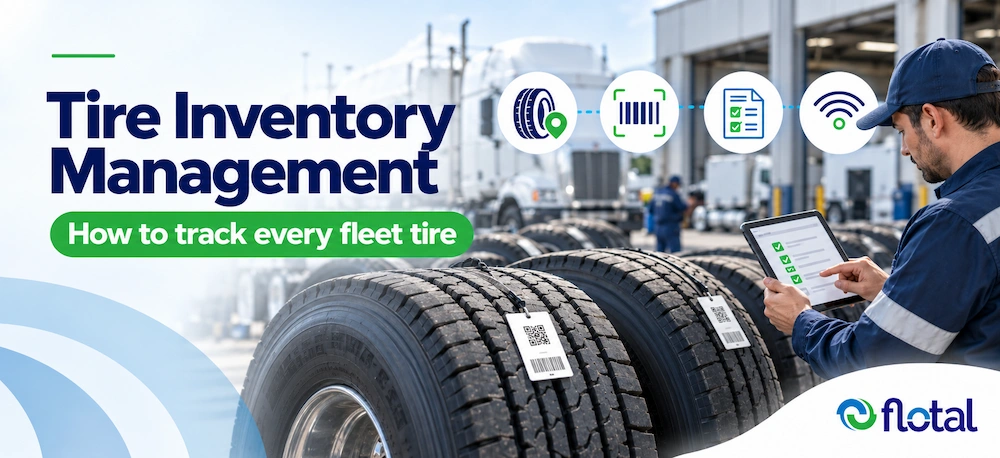
Tire Inventory Management

How to Track Every Fleet Tire?
Tire inventory management helps commercial fleets know which tires they own, where each tire is located, which vehicle it is mounted on and what has happened throughout its operating life.
For a fleet, tire inventory is not limited to products stored in a warehouse. It also includes tires installed on trucks and trailers, sent for repair, transferred between locations, awaiting retreading or permanently retired.
The challenge is maintaining accurate records as those tires move across the operation.
What Is Tire Inventory Management for Commercial Fleets?
Tire inventory management is the process of identifying, recording and controlling tire assets throughout their operational lifecycle.
Unlike inventory management in a tire retail business, fleet tire management must account for individual tire movements and service history.
A commercial fleet needs to distinguish between tires that are:
- Available in inventory
- Installed on vehicles
- Removed and awaiting inspection
- Under repair
- Sent for retreading
- Transferred between facilities
- Permanently retired
Every status change should correspond to an identifiable tire and a documented operational event.
This information helps fleet managers understand both physical inventory and the condition of the tire assets used by the business.
Why Fleet Managers Lose Track of Tires Across Their Operations
Tires frequently move between vehicles, maintenance facilities and external service providers.
A tire may be purchased for one location, installed on a truck, removed during maintenance, sent for repair and later returned to another vehicle.
Without a consistent identification and recording process, these movements can create inventory discrepancies.
Common problems include incomplete installation records, inconsistent tire identification, unrecorded transfers and uncertainty about the status of casings sent for retreading.
Managing information across multiple spreadsheets may also make it difficult to establish one reliable version of each tire’s history.
The larger the fleet, the more important it becomes to standardize how every movement is documented.
What Information Should Every Tire Inventory Record Include?
A useful tire inventory record should identify both the tire itself and its current operating status.
| Data field | Purpose |
|---|---|
| Unique tire ID | Distinguish one tire from another |
| Brand and model | Identify the tire specification |
| Tire size | Confirm the applicable specification |
| Purchase date and cost | Preserve acquisition information |
| Current location | Identify the tire’s physical location |
| Vehicle and wheel position | Record where the tire is installed |
| Installation and removal history | Track movements and service periods |
| Mileage | Document accumulated service |
| Inspections and condition | Maintain operating history |
| Repairs and retreads | Record lifecycle events |
| Current status | Identify whether the tire is in service, available or retired |
These fields help the fleet connect inventory control with maintenance and financial records.
A unique identification method is especially important because two tires of the same brand and size may have very different service histories.
How to Track Tires Across Vehicles, Warehouses and Service Locations
A consistent tire tracking procedure starts when a tire enters the fleet’s inventory.
At acquisition, the tire receives or is associated with a unique identification record.
When it is installed, the record should identify the vehicle, position, date and relevant odometer reading.
When the tire is removed, the new status and destination should also be documented.
For example, a tire removed from a drive axle might be transferred to a maintenance facility for inspection. Its inventory status should reflect the transfer, while its service history remains associated with the same tire identification.
A movement should not be treated as complete until both the physical location and the inventory record agree.
This process provides the foundation for traceability across the fleet.
Tracking Tire Installations, Removals, Repairs and Retreads
A complete fleet tire history extends beyond the current location.
Installation and removal records help establish where and when the tire operated.
Repair records document service events and associated expenses.
When the fleet uses retreading, the tire’s record should preserve the relationship between the original casing and subsequent service cycles.
This allows managers to review the complete history instead of treating every installation or retread as an unrelated inventory item.
For a broader explanation of how service cycles influence asset value, see our upcoming article on semi truck tire lifespan (internal link pending).
How to Improve Tire Inventory Accuracy and Traceability
A reliable tire inventory process requires standardized procedures and consistent data capture.
Fleet managers should establish clear responsibilities for recording acquisitions, installations, removals and transfers.
Periodic physical inventory checks can help detect differences between actual tire locations and digital records.
It is also important to reconcile inventory with maintenance activity. If a tire was removed from a vehicle but remains listed as installed, the record should be investigated and corrected.
The goal is a trustworthy operating history rather than an inventory count that is accurate only at the moment of purchase.
How Tire Control Software Helps Manage Fleet Tire Inventory
For commercial fleets, Flotal’s tire control software provides a centralized platform for tire identification, inventory, location, installations, removals, repairs, retreads and individual lifecycle histories.
The platform also supports recording tire condition, mileage and associated costs, connecting inventory information with maintenance and performance analysis.
Instead of maintaining disconnected records for purchasing, warehouse inventory and vehicle maintenance, fleet teams can work from centralized tire information.
This makes it easier to investigate inventory discrepancies, understand tire movements and evaluate how assets are being used throughout the fleet.
Effective tire inventory management means knowing more than how many tires you have. It means knowing where every tire is, what condition it is in and how it has been used.
Explore Flotal’s tire control software for fleets to learn how centralized tire inventory and lifecycle tracking can support your operation.
Más artículos
Ver todos →
How Long Do Semi Truck Tires Last?
Maximizing Tire Life and Value How long do semi truck tires last? There is no universal mileage or service period that applies to every commercial truck ti…

Semi Truck Tire Tread Depth
Are You Retiring Tires Too Early? Semi truck tire tread depth is an important measurement for evaluating tire condition and determining whether a commercia…

Semi Truck Tire Wear Patterns: Causes and What They Mean
Semi truck tire wear patterns can reveal important information about a vehicle’s operating conditions. Uneven tread wear may indicate inflation probl…